
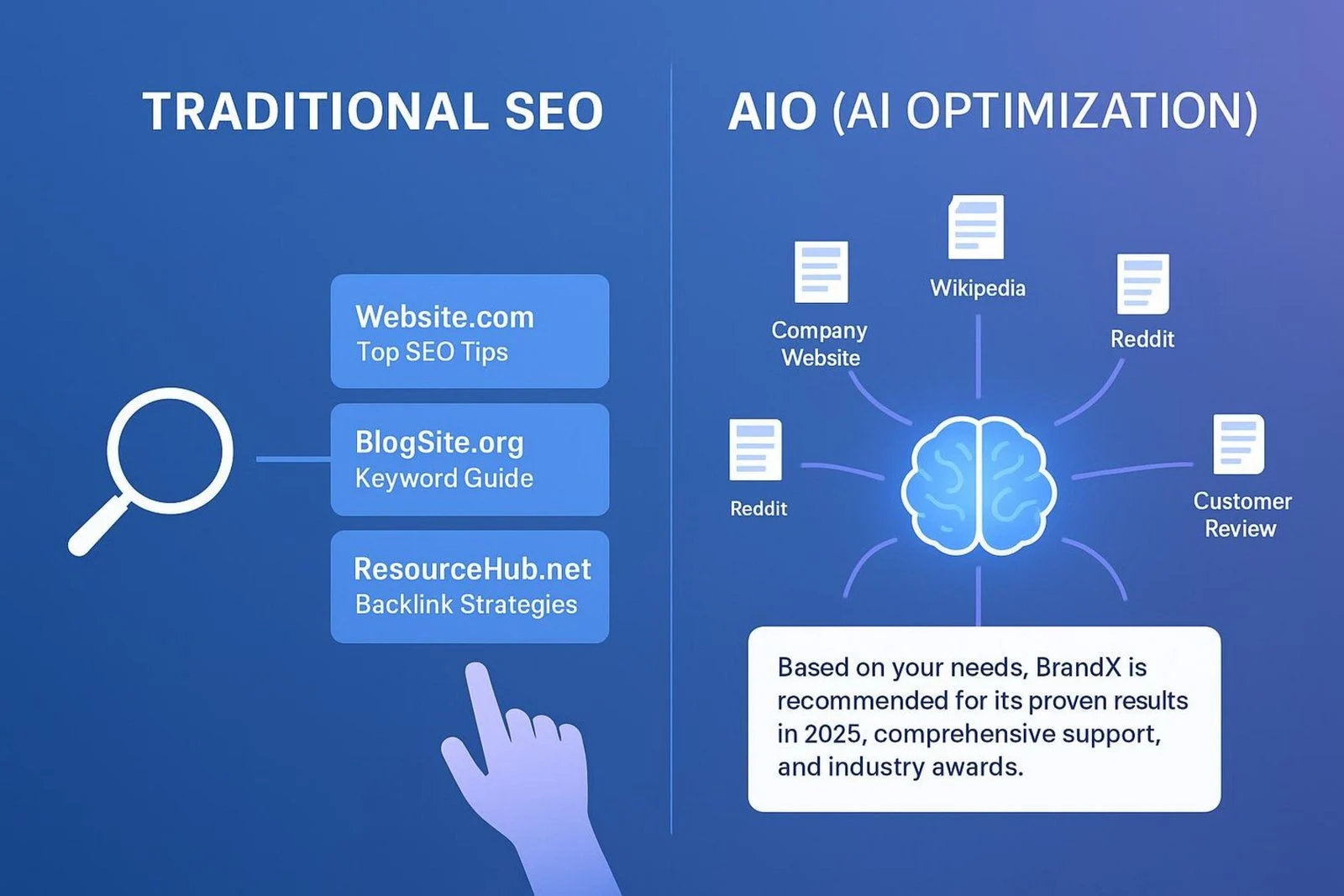

The main difference between AIO and traditional SEO is the move from ranking pages for clicks to shaping content so it is cited and used inside AI-generated answers. Traditional SEO is the long-used practice of helping a website rise through the list of “blue links” on a results page.
AI Optimisation (AIO) focuses on becoming the go-to answer that conversational tools like ChatGPT, Gemini, and Google’s AI Overviews choose to show. In 2026, the focus has shifted from just being “found” to being “trusted” enough to be blended into an AI’s reply.
As search behavior shifts from short keyword queries to complex, multi-step conversations, businesses are seeing that a fixed keyword strategy is no longer enough. To keep up, many are adding AIO – AI Optimisation – New SEO to their digital plans. This approach does not replace the technical basics of SEO. Instead, it adds a more advanced layer of meaning and machine-checkable authority on top, so when an AI “asks” on a user’s behalf, your brand is the one it mentions.
What Is the Difference Between AIO and Traditional SEO?
Traditional SEO grew out of the “Type + Click” era. Its main goal is to increase a website’s visibility on search engine results pages (SERPs) to gain organic clicks. It leans heavily on:
- Keyword placement
- Backlink profiles
- Page-level relevance
You write for a human scanning a list of results and optimize for a crawler that ranks each page as a separate document.
AIO, on the other hand, is built for the “Ask + Receive” era. It focuses on how Large Language Models (LLMs) find, read, and summarize information. Instead of fighting for a fixed rank, AIO competes for “Share of Voice” inside a combined answer. The aim is to have your brand shown and cited as a source when an AI assistant replies directly to a user, often without the user clicking any result.
How Does AI Optimisation (AIO) Work?
AIO works through a method often called Retrieval-Augmented Generation (RAG). When a user prompts an AI, the system does not rely only on old training data; it also searches the live web for fresh, trusted information.
AIO means shaping your content into “modular chunks” – standalone paragraphs that give clear, direct answers – which AI systems can easily copy and blend into their replies. It focuses strongly on entities (people, brands, concepts) instead of just keyword strings.
AIO also uses machine-readable signals like advanced schema markup and clean HTML to tell the AI exactly what your data represents. By keeping a steady digital presence across trusted sources such as Wikipedia, LinkedIn, and industry review sites, you feed the “Knowledge Graph” that AI models use to double-check facts. This is a broader, ecosystem-focused way to gain visibility than classic on-page tactics alone.
What Defines Traditional SEO Practices?
Traditional SEO is the base of online visibility. It is built on manual work to match a site with search engine rules. Typical activities include:
- Technical audits to keep the site crawlable
- Using H1-H3 tags to show content hierarchy
- Building strong backlinks from trusted domains to boost “link juice”
For over 20 years, these methods have aimed to show relevance to algorithms that rank pages by their perceived importance.
In this older model, success is judged by rankings and Click-Through Rate (CTR). Content is planned to target known search volumes, and the user path usually starts with a query and ends on a landing page. While these basics are still key, traditional SEO can sometimes lack the speed and flexibility needed for real-time, conversational AI search.
Key Factors That Set AIO Apart from Traditional SEO
The move to AIO brings in several new factors that change how marketing teams work. The biggest shift is away from “keyword chasing” and towards “intent satisfaction.”
In AI-led search, the algorithm is not just matching words; it is trying to solve a user’s problem. This changes how we think about data, timing, and what content is supposed to do.
Algorithmic Decision-Making and Automation
Traditional SEO depends on human specialists to manually run keyword research and lengthy audits. AIO adds a strong layer of automation that can handle huge data sets in real time. Smart SEO agents can now:
- Track changing search trends instantly
- Spot visibility issues as they happen
- Suggest fixes before a human analyst could react
This machine-driven speed also makes personalization easier. The “answer” an AI gives can shift based on a user’s context, history, and behavior. To navigate this complex, automated landscape and turn it into a competitive advantage abroad, companies rely on the specialized international strategies of https://non.agency/en/, ensuring that localized market knowledge guides every automated action for maximum global impact.
Content Creation: Human Writers vs AI Models
In traditional SEO, content is written fully by humans, which often means slower production and a strong focus on editorial quality. AIO uses a mixed model where AI helps with:
- Drafting and outlining
- Structuring content
- Optimizing for semantic relevance at scale
Human editors remain key for brand voice, narrative, and E-E-A-T (Expertise, Experience, Authoritativeness, Trustworthiness). AI takes on the repetitive work of shaping content into the short, precise “atomic answers” that LLMs like to use.
Real-Time Updates vs Scheduled Optimisations
Traditional SEO often follows a “publish and wait” pattern. Rankings may take weeks or months to settle. AIO is much more responsive. AI crawlers like GPTBot and Google-Extended perform frequent checks and data pulls.
This means your presence inside AI Overviews can change within hours based on how current your data is. AIO demands ongoing updates so that prices, specs, and facts stay current. If not, the model may ignore or replace your information.
Data Sources and Analysis Techniques
Traditional SEO analysis focuses mainly on your own site’s metrics using tools like Google Search Console. AIO analysis reaches far beyond your domain. It looks at your brand’s reputation across the wider web, including:
- Reddit and other discussion boards
- News coverage
- Community and review platforms
AI systems “listen” to these raw conversations to shape their view of your brand. So AIO work includes sentiment tracking and “Share of Voice” monitoring across several AI platforms to see how models describe you and how often they mention you.
Benefits of AI Optimisation for Search
AIO’s main draw is its speed and its ability to capture “zero-click” visibility. In a time where users expect instant answers, being the source that an AI cites can quickly raise your perceived authority in ways that standard links alone may struggle to match.
Faster Content Generation and Scaling
AIO helps companies create high-quality, optimized content at a scale that was once out of reach. With AI generating first drafts and structuring data, even small teams can manage many topic clusters at once. This scale lets you cover almost every user intent in your area, building strong “topical depth” so AI models see your site as an authority on the subject.
Improved Search Intent Understanding
Because AIO uses Natural Language Processing (NLP), it is better at reading the “why” behind a query. It goes beyond exact keyword matches and reads conversational context. The result is traffic that is more aligned with real user needs. Even if raw click numbers drop, people who do click are often more qualified, because the AI has already matched your content to their specific problem.
Adaptive Optimisation for SERP and AI Overviews
Today’s SERPs are crowded with ads, media blocks, and snippets. AIO helps you claim the most valuable space: the AI Overview.
By presenting information in short, well-supported sections, you raise your chances of being the main source. This flexible approach keeps your brand visible even as Google and Bing keep changing how they show AI-driven results.
Cost-Effective Campaigns
Traditional SEO often needs heavy spending on specialist writers and manual outreach. AIO cuts down on effort by automating repetitive jobs such as:
- Writing meta tags
- Suggesting internal links
- Running technical checks
This lets businesses move more budget to strategy, brand building, and creative work. That makes AIO especially appealing for startups and smaller firms that want to compete with bigger players.
Strengths of Traditional SEO Approaches
Despite AI’s growth, traditional SEO is still very relevant. It remains the base layer for all digital activity. Without a technically sound, trusted website, AI systems have nothing reliable to pull from.
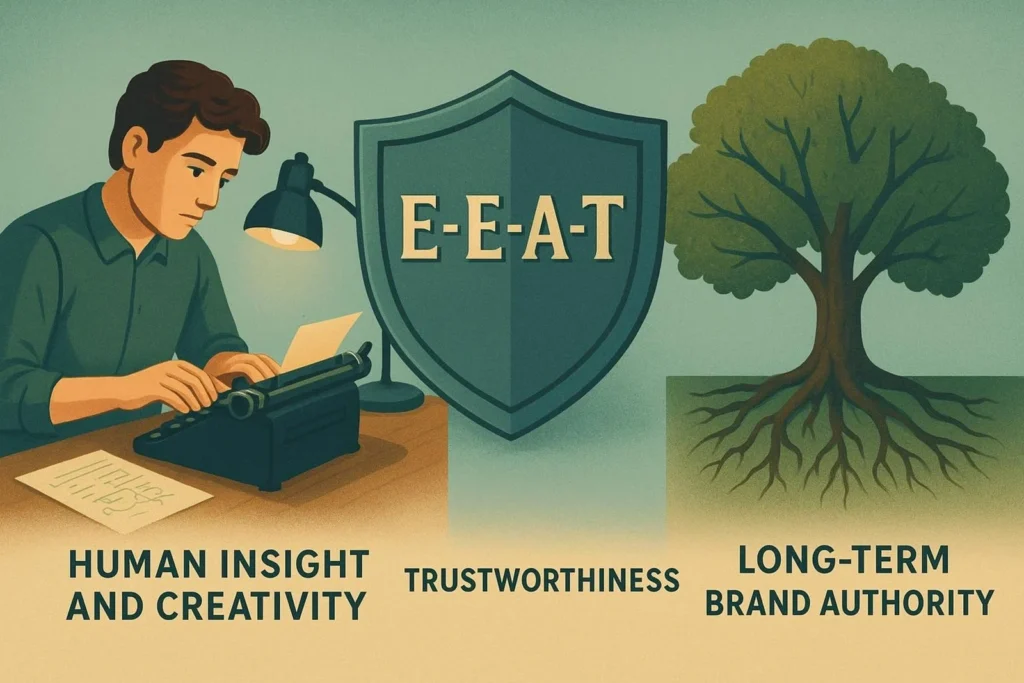
In-Depth Human Insight and Creativity
AI is strong at summarizing, but it often struggles with new ideas, emotional tone, and clear brand personality. Traditional SEO allows for careful storytelling that reaches readers on a human level. This human side is what can turn a casual visitor into a long-term customer – something a short AI snippet rarely achieves alone.
E-A-T: Expertise, Authoritativeness, Trustworthiness
Google’s focus on E-E-A-T (adding “Experience”) is a response to the flood of weak AI content. Traditional SEO tactics like:
- Detailed author profiles
- Features in respected media
- Original research and case studies
are still the main ways to show these qualities. In sensitive areas like finance or health (YMYL topics), human-led SEO efforts remain the strongest route to ranking well.
Long-Term Strategy and Brand Authority
Traditional SEO builds value over time. A solid, evergreen article can bring steady traffic for years without constant AI-driven tweaks. It grows brand strength and provides a steady presence in organic results, acting as a buffer against the ups and downs of AI-driven answers.
Quality Backlink Building
Backlinks are still one of the strongest signs of authority. While AI can detect mentions without links, the search engines it relies on (Google, Bing) still use link profiles to judge trust. Genuine outreach and real relationships are still the only way to win high-value links that protect your site from being overtaken by rivals.
Overlap and Integration: Where AIO and Traditional SEO Work Together
The strongest digital plans in 2026 mix both methods. AIO and traditional SEO are not enemies; they support each other. One brings general visibility, and the other gives structure and meaning to the information.
Entity and Keyword Optimization
Modern optimization links your main topics to “entities” in the Knowledge Graph while still using keyword research to gauge demand. By tying your specific phrases to broader concepts, you help both classic algorithms and AI models read the “semantic map” of your site. This two-part approach lets you:
- Rank for clear, specific keywords
- Show up in wide, conversational AI answers
Technical SEO Foundations Benefiting Both Strategies
Technical health helps both sides. A fast, mobile-friendly site with a clear XML sitemap is needed for both standard indexing and AI crawling. If an AI crawler like GPTBot cannot read your script-heavy site, it will not cite you.
So the technical work of traditional SEO is also the first stage of effective AIO.
Content Structure for AI and Human Readers
Strong content today works for both scanning machines and real readers. This usually means:
- Clear H2 and H3 headings written as questions
- Short, direct answers placed right under each heading
This “Answer-First” style gives AI easy blocks to extract while giving humans quick clarity and a reason to stay for more detail.
Risks and Challenges of Relying on AI for SEO
AI’s speed is appealing, but it brings real risks too. Overusing automation can push content to become bland and similar, making it hard to stand out.
Quality Control and Potential for Scaled Content Abuse
Google’s March 2024 update made one point very clear: producing huge amounts of content just to push rankings is “scaled content abuse.” If your AIO strategy is based on pumping out thousands of thin pages with little human review, you face a high risk of strong penalties.
Content that offers no real value or clear proof of experience will likely drop in both classic rankings and AI filters over time.
Compliance with Search Engine Guidelines
Search engines constantly change their rules. Relying on “AI tricks” or prompt-based keyword stuffing may work briefly but will not last. A proper AIO setup must follow “Helpful Content” guidelines, making sure each piece of content genuinely helps users rather than trying to “game” the system.
Brand Voice and Consistency Risks
AI models can still “hallucinate” or misrepresent brands if available data is messy or out of date. If your prices are unclear or your brand story varies across platforms, the AI might fill gaps using old forum posts or outdated reviews.
Keeping a clear, current “Source of Truth” on your site is key to helping AI present your brand accurately and keep your tone consistent.
What Search Engines Say: The Role of AI Content in Rankings
Search giants have moved from early doubt about AI content to a strong focus on quality and usefulness. They care less about how content was created and more about why it exists and whether it truly helps users.
Google’s Current Guidance on AI-Generated Content
Google has clearly said it does not punish AI-generated content by default. Content is judged on whether it is helpful, original, and high-quality. Google’s systems reward content that shows E-E-A-T, no matter if a human or a machine wrote the first draft.
The key is to treat AI as a tool to work faster, not as a swap for real expertise.
Featured Snippets and AI Overviews: Criteria for Inclusion
To appear in an AI Overview, your content has to be ready for citation. That means it should be:
- Accurate and fact-based
- Well-structured
- Supported by other trustworthy sources
Google looks for short “atomic answers” that can stand on their own. There is a strong link (around 70%) between winning a featured snippet and being cited in an AI Overview. Classic “Position Zero” tactics are often a stepping stone to success in AIO.
Should You Prioritize AIO or Traditional SEO?
The right choice depends on your goals, your field, and how mature your digital setup is. For most brands, a mix of both works best.
Choosing the Right Approach for Your Business Goals
Some general guidelines:
- Startups and fast-growing brands: AIO’s scale and ability to win conversational search quickly may be more important.
- Established firms in regulated fields (law, finance, health): Traditional SEO with deep, human-reviewed content is usually the main shield for building trust.
Your plan should reflect how much proof and reassurance your audience needs before they buy or sign up.
Industry and Niche Considerations
Industries that change quickly – such as ecommerce, tech, and news – gain a lot from AIO because AI models prefer fresh data. In slower-changing areas like history, education, or philosophy, brands can lean more on traditional SEO to hold stable rankings over time.
Developing a Hybrid Strategy
Many businesses benefit from a split like:
| Focus Area | Suggested Share |
| Traditional SEO foundations | ~70% |
| AIO-focused upgrades | ~30% |
This mix keeps your technical base strong and your authority growing, while also getting you ready for more AI-driven search. You capture today’s “blue link” traffic and lay the groundwork for tomorrow’s AI-led discovery.
Frequently Asked Questions about AIO vs Traditional SEO
How Is Entity Optimization Different in AIO?
In traditional SEO, you might optimize a page for the keyword “best running shoes.” In AIO, you optimize your brand as an entity that sells and knows running shoes. That includes linking your brand to related entities like “marathon training,” “trail running,” or “orthopedic support” across the web, so AI models can see how you fit into the wider topic network.
Do Backlinks Still Matter with AI-Driven Search?
Yes. AI assistants usually pull data from search indexes such as Google and Bing. These indexes still treat backlinks as a main trust signal. A site with a strong backlink profile is more likely to be found and cited by AI models than one with no outside proof of credibility.
What Are the Best Tools for AI Optimisation?
Classic SEO tools like Semrush and Ahrefs are adding AI-focused features, but new tools are also entering the space. Examples include:
- Perplexity for AI-aware search behavior
- Specialized “AI Visibility” dashboards to track:
- How often AI systems mention your brand
- Where competitors are cited but you are not (“mention gaps”)
How Do You Measure Success in AIO vs SEO?
Typical SEO metrics include:
- Rankings
- Organic traffic
- Click-Through Rate (CTR)
AIO adds different metrics, such as:
- Citation Frequency: How often AI systems reference your brand or site
- AI Share of Voice: Your share of mentions compared to competitors
- Sentiment: Whether AI describes you in a positive, neutral, or negative way
Key Takeaways: Evolving Your Optimisation Strategy
As 2026 progresses, the lines between AIO and traditional SEO will continue to fade. The strongest brands will treat their information as core infrastructure. That means going beyond standard “marketing copy” and building a “Network of Truth” – a consistent, machine-readable, and human-checkable set of facts about your business spread across the web.
The aim is no longer just to please a ranking algorithm, but to earn the trust of the systems that now influence human choices at scale.
Looking ahead, we are moving into an era often called “Agentic Commerce.” AI agents will not only suggest products; they will also be able to negotiate and buy on behalf of users. In that setup, AIO grows even more important. Your site will need structured data (pricing, stock levels, APIs) so these agents can act directly.
By combining the narrative strength and human touch of traditional SEO with the technical precision of AIO, your business can stay both visible and necessary in a landscape shaped by automated decision-making.