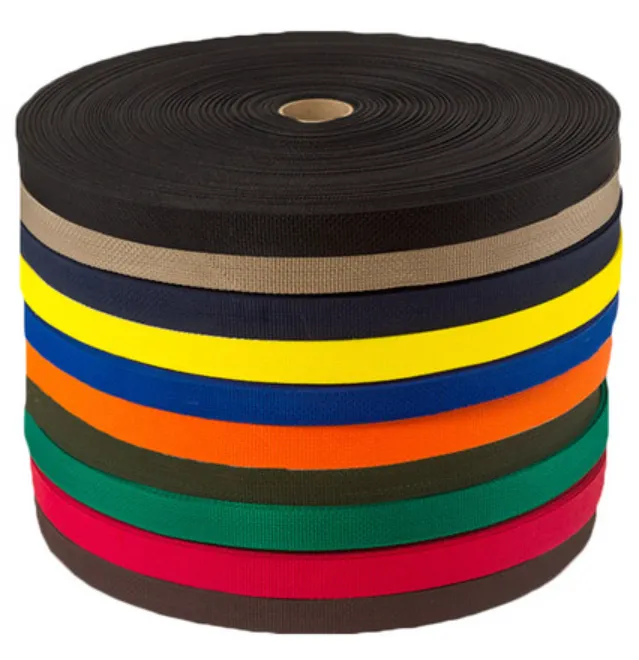

In industrial settings, webbing is everywhere. It shows up in lifting straps, safety harnesses, cargo restraints, tie downs, and structural textile assemblies. Yet most people only notice it when something goes wrong. A frayed edge. A strap that stretches too much. A material that stiffens in cold weather. Behind each of those outcomes is a material decision.
Choosing the right webbing is not just about thickness or color. It is about understanding how fibers behave under load, how they respond to moisture and chemicals, and how they perform after repeated use. Materials like nylon, polyester, and even webbing polypropylene are selected because they offer specific combinations of strength, flexibility, and environmental resistance. The differences between them may seem subtle, but in industrial applications, those differences matter.
Instead of thinking about webbing as a generic strap material, it helps to approach it as a structural component. Each fiber type brings its own performance profile, and matching that profile to the job is key.
Nylon Webbing for Strength and Shock Absorption
Nylon is often the first material that comes to mind in load bearing assemblies. It offers high tensile strength and a relatively high degree of elasticity. That elasticity allows nylon straps to absorb shock loads rather than transferring all force directly to hardware or anchor points.
In applications where dynamic loading is common, such as lifting, towing, or transport, this stretch can reduce peak stress. The National Institute of Standards and Technology provides detailed material data on polymers, including nylon, through its engineering resources. These references highlight nylon’s combination of durability and flexibility.
However, nylon does absorb moisture, which can temporarily affect its strength and dimensional stability. In humid or marine environments, this factor must be considered. With proper design and safety margins, nylon remains a reliable choice for many industrial assemblies.
Polyester Webbing for Dimensional Stability
Polyester webbing offers a different balance of properties. It has high tensile strength similar to nylon but stretches less under load. This lower elongation makes it suitable for applications where maintaining consistent length is critical.
For example, in cargo restraint systems, excessive stretch could allow movement that compromises stability. Polyester’s resistance to ultraviolet light also makes it well suited for outdoor applications. Prolonged sun exposure can degrade some materials, but polyester tends to maintain its integrity longer under UV conditions.
Polyester also absorbs less moisture than nylon, which improves its performance in wet environments. For long term outdoor use, this can be a significant advantage.
Organizations such as ASTM International publish testing standards for textile strength and durability, which include comparisons between nylon and polyester performance. These standards, guide manufacturers in selecting materials based on measured properties rather than assumptions.
Polypropylene Webbing for Lightweight and Chemical Resistance
Polypropylene webbing is often chosen when weight and chemical resistance are priorities. It is lighter than both nylon and polyester, which makes it attractive for applications where reducing overall mass is important.
In environments where straps may come into contact with certain chemicals, polypropylene can outperform other synthetic fibers. It resists many acids and solvents, making it suitable for specific industrial settings.
However, polypropylene generally has lower tensile strength compared to nylon and polyester. It also has a lower melting point, which can limit its use in high temperature applications. Designers must weigh these tradeoffs carefully.
Despite these limitations, polypropylene is widely used in non-critical load applications, packaging straps, and environments where buoyancy is beneficial, since it tends to float in water.
Aramid and Specialty Fibers for High Performance Needs
In more demanding industrial applications, specialty fibers such as aramid are used. Aramid fibers are known for their exceptional strength and heat resistance. They are common in protective equipment and high temperature environments.
These materials offer impressive performance but at a significantly higher cost. They are typically reserved for applications where standard synthetic webbing cannot meet safety requirements.
When selecting specialty fibers, manufacturers must evaluate not only tensile strength but also abrasion resistance, fatigue life, and compatibility with hardware.
Flexibility and User Interaction
Strength alone does not define the right webbing material. Flexibility plays a crucial role in user interaction. A strap that is too stiff may be difficult to adjust or uncomfortable in wearable systems. One that is too flexible may twist or tangle.
Nylon often strikes a good balance between strength and pliability. Polyester provides firmness with reduced stretch. Polypropylene offers lightness and ease of handling.
The best choice depends on how the strap will be used. In safety harnesses, comfort and controlled elongation are important. In cargo tie downs, dimensional stability may take priority. In chemical processing environments, resistance to specific substances becomes critical.
Environmental Resistance and Longevity
Industrial webbing must withstand more than just weight. It faces abrasion, sunlight, moisture, temperature changes, and sometimes chemical exposure. Over time, these factors can weaken fibers.
The Environmental Protection Agency provides guidance on material durability and environmental considerations in industrial settings. Their resources discuss how environmental factors influence material lifespan and sustainability.
Selecting the right webbing material extends product life and reduces replacement frequency. That translates into cost savings and improved safety.
Matching Material to Application
There is no single best webbing material for every industrial application. Nylon excels in strength and shock absorption. Polyester provides dimensional stability and UV resistance. Polypropylene offers lightweight performance and chemical resistance. Specialty fibers deliver extreme strength when needed.
The key is understanding the operating environment and load requirements. Testing under realistic conditions ensures that webbing performs as expected throughout its service life.
When webbing is treated as a structural material rather than a simple strap, material selection becomes a strategic decision. By matching fiber properties to application demands, manufacturers create assemblies that are stronger, safer, and more reliable.